

Horace-Bénédict de Saussure
Biography
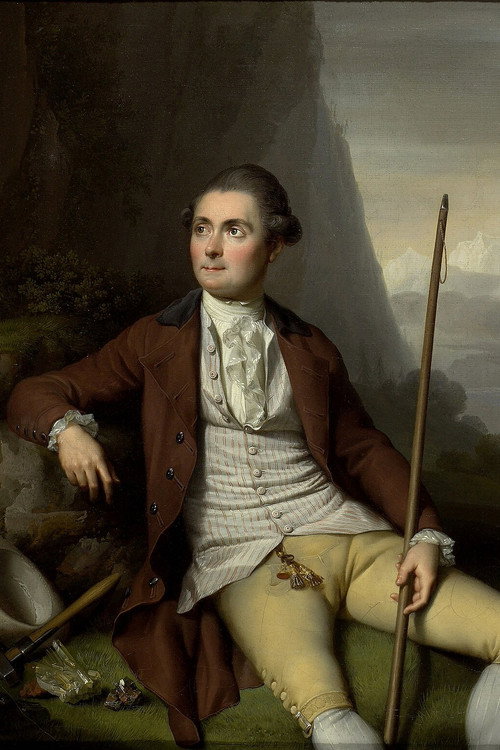
Horace Bénédict de Saussure (French: [ɔʁas benedikt də sosyʁ]) was a Genevan geologist, meteorologist, physicist, mountaineer and Alpine explorer (specifically the Mont Blanc massif), often called the founder of alpinism and modern meteorology, and considered to be the first person to build a successful solar oven.
He was born in Conches, near Geneva, in the Republic of Geneva. Saussure's family were Genevan patricians. His father, Nicolas de Saussure, was an agriculturist, agronomist and author. Because his mother was "sickly", Saussure was brought up by his mother's sister and her husband the Genevan naturalist Charles Bonnet, who sparked Horace-Bénédict's early interest in botany. After attending the "Collège" of his hometown, he completed his studies at the Geneva Academy in 1759 with a dissertation on heat (Dissertatio physica de igne).
In 1760, Saussure made the first of numerous trips to Chamonix valley, to collect plant specimens for the noted Swiss anatomist, physiologist and botanist Albrecht von Haller. In 1760, Saussure offered a reward to the first man to reach the summit of Mont Blanc. Inspired by his uncle, Charles Bonnet, the young Saussure researched the physiology of plants which he published as Observations sur l'écorce des feuilles et des pétales in 1762.
The same year, at 22, he was elected professor of philosophy at the "Academy of Geneva", where he lectured on physics one year, and on logic and metaphysics the next. He taught there until 1786, occasionally also lecturing on geography, geology, chemistry, and even astronomy.[citation needed]
Saussure's early interest in botanical studies and glaciers soon led him to undertake other journeys across the Alps. In 1767, he completed his first tour of Mont Blanc, a trip that did much to reveal the topography of the snowy portions of the Alps of Savoy. He also carried out experiments on heat and cold, on the weight of the atmosphere and on electricity and magnetism. For this, he devised what became one of the first electrometers. From 1772 to 1773 trips led him to Italy, where he studied Mount Etna and other volcanoes (1772–73), and to the extinct volcanoes of the Auvergne, in France.
Although a patrician, Saussure held liberal views, which induced him to present in 1774 a plan for the development of scientific education in the Geneva College, which would be open to all citizens, but this attempt failed. He was more successful in advocating the creation of the "Société des Arts" (1776), inspired by the London Society for the Improvement of Arts.
Beginning in 1774, Saussure sought to reach the summit of Mont Blanc on the side of Val Veny (now Italy) accompanied by the Courmayeur alpine guide Jean-Laurent Jordaney on the Miage Glacier and on Mont Crammont. In 1776, he ascended the Buet (3,096 m). He climbed the Crammont in 1774 and again in 1778, in which year he also explored the Valsorey glacier, near the Great St Bernard. In 1780, he climbed the Roche Michel, above the Mont Cenis Pass. In 1785, he made an unsuccessful attempt on Mont Blanc by the Aiguille du Goûter route. Two Chamonix men, Michel Paccard and Jacques Balmat, attained the summit in 1786, by way of the Grands Mulets, and in 1787 Saussure himself made the third ascent of the mountain. His achievements did much to attract tourists to places such as Chamonix.
Personal Info
Known For
Acting
Known Credits
2
Gender
Male
Birthday
1740-02-17
Place of Birth
Conches, Republic of Geneva
Also Known As
—