PostCut_The_Film_Podcast
⭐ 8/10
May 23, 2021
<div id="buzzsprout-player-8546506"></div>
<script src="https://www.buzzsprout.com/1610599/8546506-the-brainburner.js?container_id=buzzsprout-player-8546506&player=small" type="text/javascript" charset="utf-8"></script>
Listen to the full review above!
"For anybody of a given age or someone who is a real cinephile... You only need to hear... David Lynch. The first impression I had was tension, then I watched it again... it's nightmarish.…
read the rest.
<div id="buzzsprout-player-8546506"></div>
<script src="https://www.buzzsprout.com/1610599/8546506-the-brainburner.js?container_id=buzzsprout-player-8546506&player=small" type="text/javascript" charset="utf-8"></script>
Listen to the full review above!
"For anybody of a given age or someone who is a real cinephile... You only need to hear... David Lynch. The first impression I had was tension, then I watched it again... it's nightmarish." David M. Brown.
"It's one of those things that can only be described as a lucid dream come to life. It takes a certain caliber of person to actually put out work like that. And it's not crazy.... It's Genius." Sarah Peterson.
"Definitely a brain Burner. It was definitely the weirdest movie I've watched. I can't describe this movie in words... It's not of this earth. I want to go sit in a corner in a dark place and think. This is not a movie.... It's beyond a movie." David Veerkamp
show less
Sigeki Ogino
October 2, 2022
We believe that films should "make people happy" (euphoria). No, we believe it should. Of course, there were thorny issues in getting there.
I used to say that "movies are the art version of pornography" if there was even a hint of sexuality, and in middle and high school I mainly watched "erotic" movies ("A Clockwork Orange" being the first of these).
Looking back, I was a "foolish spectator." One day, however, a change came to me. I believe t…
read the rest.
We believe that films should "make people happy" (euphoria). No, we believe it should. Of course, there were thorny issues in getting there.
I used to say that "movies are the art version of pornography" if there was even a hint of sexuality, and in middle and high school I mainly watched "erotic" movies ("A Clockwork Orange" being the first of these).
Looking back, I was a "foolish spectator." One day, however, a change came to me. I believe that an encounter with a movie can change your life, and the movie I encountered was "Mulholland Drive," which turned my view of movies upside down, saying, "I have never seen a movie like this.
Until then, to my surprise, I had never even heard of David Lynch (I'm embarrassed to say ‼︎).
From memory, between the ages of 12 and 13, I saw this surreal, showbiz-crazed entertainment at least a dozen times and was not only never bored, but drawn in. Isn't that amazing?
I mean, "It was a 'monumental' movie in my life" (my strongest experience in a movie theater was when I saw "The Return of the King"). ......
So I had to see this film by a great filmmaker. In comparison, "Lost Highway" was an insignificant film.
Honestly, I don't know, but it seemed to be well received by the public. However, this is a common phenomenon.
A friend says, "This movie is interesting," so I take his opinion and watch it, only to find that it is actually not that interesting.
Now it has become my "rule" and "motto" to "choose my own movies."
Even 'Blue Velvet,' which is considered Lynch's best film, was really bad." What is so interesting about David Lynch?" I am often asked. It is difficult to answer this question.
In fact, even if he had retired from the film industry after one film, "Mulholland Drive," David Lynch would still be revered as the king of surrealist cinema, but my "Lynch experience" ends there. However, it was "Eraserhead" that started my "Lynch experience" back to the classics, and that is where it should have ended.
This creepy, nightmarish film, which even psychotic patients can't hold (and if Lynch portrays psychosis, he certainly sucks at it), was released in 1978 and although it didn't gain immediate popularity, it did gain a cult following by being shown in drive-in theaters and elsewhere.
"What is this creepy movie?"
I was astonished to learn that this movie was made in 1977. There were few ups and downs in the story and no visual beauty.
It was just a dusty, sandy factory area. An alien obsessed with the "peculiar hairstyle" of the main character, played by Jack Nance, gives birth to a deformed child and is sexually abused by his stepmother.
It is the story of Mary, the "crazy fiancée" who gave birth to the deformed baby and abandoned him, her sexual neighbors, and the puppies who suck chubby titties from the female dog. The chicken at the table runs like clockwork.
The "deformed" baby cries and we dissect it. The "vomit" comes down our throats, and it's painful to watch. Frankly, it made me sick. Was it my fault or the movie? Was it Jack Nance's fault?
By the way, please don't assume that "Eraserhead" is super difficult to understand. To me, Christopher Nolan's films are esoteric, but David Lynch's films are not so esoteric if you are in a position to "watch" them. The images may be boring because they embody a world that could happen to anyone (e.g., insanity or psychosis), but Lynch would not want to make it "esoteric."
Eraserhead is, in short, experimental science fiction (not breathtaking "entertainment") only in the guise of "surrealism."
It begins with two shots of "Henry" and a "deformed child" drifting through "outer space," and eventually a creepy woman appears in "high places" and "deep waters."
The "factory zone" and "outer space" are connected until the creepy woman sings "In Heaven." The "Alien Child" is in "intergalactic union" with the man from "The Distant Star" and Henry Spencer.
show less
captain_douche
December 8, 2024
Straight up: I don't like this movie. It is a grotesque, bizarre horror movie. There is no real plot. The only thing this movie will do is make you feel uncomfortable. It makes you feel like in a bizarre nightmare. And this it does really well. I give it 3 stars for the artistic creation that it is and the effect it can create on the audience.
Disclaimer: I walked out of the cinema after 3/4 watching...
misubisu
⭐ 10/10
June 28, 2026
Score: 10/10 A Singular, Unshakeable Vision of Nightmare Cinema
Eraserhead is not a film you watch; it is a film you survive. It is a descent into a world that feels both alien and uncomfortably familiar—a surrealist nightmare that operates on dream logic, industrial dread, and the visceral terror of parenthood. David Lynch's feature debut is a landmark of avant-garde cinema, a work so singular and uncompromising that it defies comparison. It…
read the rest.
Score: 10/10 A Singular, Unshakeable Vision of Nightmare Cinema
Eraserhead is not a film you watch; it is a film you survive. It is a descent into a world that feels both alien and uncomfortably familiar—a surrealist nightmare that operates on dream logic, industrial dread, and the visceral terror of parenthood. David Lynch's feature debut is a landmark of avant-garde cinema, a work so singular and uncompromising that it defies comparison. It earns a perfect score not because it is "entertaining" in any traditional sense, but because it achieves exactly what it sets out to do: it gets under your skin and stays there forever.
The Atmosphere: A World of Industrial Horror
From its opening frame, Eraserhead announces itself as something wholly unique. The film's world is a grey, grimy, industrial wasteland—a landscape of hissing pipes, buzzing lights, and a constant, oppressive mechanical drone. The sound design, by Lynch and Alan Splet, is as much a character as any of the humans on screen. It is a masterclass in auditory unease, a relentless assault of ambient noise that feels like the planet itself is in pain.
The black-and-white cinematography is stark and beautiful, evoking German Expressionism and film noir while remaining entirely its own. The visual compositions are meticulous, every frame a painting of despair and alienation. The world Lynch creates is one where the ordinary rules of reality do not apply, yet everything feels horrifyingly literal. It is a nightmare, but it is a nightmare that makes perfect, terrible sense within its own internal logic.
Jack Nance: A Performance of Suffocating Intensity
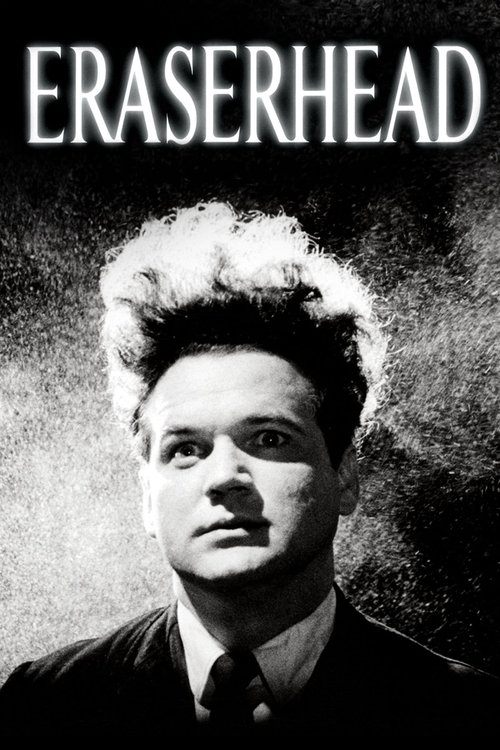
Jack Nance was amazing in this role. There is no other way to say it. As Henry Spencer, Nance delivers a performance that is simultaneously expressionless and deeply expressive. His face—with its pale, gaunt features, his hair standing on end like a man perpetually electrocuted—is a mask of quiet, bewildered suffering. He moves through the film with a kind of shuffling inertia, a man trapped in a world he cannot escape and barely understands.
Nance's physicality is extraordinary. He conveys so much with so little: the tilt of his head, the blank stare, the slow, defeated movement of his hands. He is every anxious parent, every overwhelmed soul, every person who has looked at their life and wondered how they ended up here. That he does all this without ever breaking into conventional "acting" is a testament to his singular talent. He is the beating, broken heart of a film that refuses to offer comfort.
The Baby: A Horror Beyond Words
The baby is one of the most unforgettable, disturbing creations in cinema history. It is a grotesque, vaguely fetal creature that exists in a constant state of illness and distress. It is not a metaphor; it is a presence, a living embodiment of the terror and exhaustion of new parenthood. Its cries are unbearable. Its existence is a torment. And yet, there is a strange, tragic pathos to it. Henry's attempt to care for it, to soothe it, is both heartbreaking and horrifying. It is a portrait of responsibility as a slow, inescapable suffocation.
The Lady in the Radiator: A Moment of Grace
Amidst the darkness, there is the Lady in the Radiator. Played by Laurel Near, she appears to Henry in a dream, dancing on a stage inside a glowing radiator. She sings "In Heaven, everything is fine," offering a fleeting, surreal moment of beauty and solace. It is the film's only glimpse of relief—and even that is ambiguous, tinged with the knowledge that it is merely a dream within a nightmare.
The Ending: A Vision of Apocalyptic Liberation
The final sequence of Eraserhead is one of the most powerful in all of cinema. Without revealing too much, it is a moment of transcendence that is also a moment of annihilation. It is the film's thesis statement: the only escape from this world is to destroy it. It is not a happy ending. It is not a sad ending. It is an inevitable ending—a release that feels both catastrophic and serene.
The Verdict
Eraserhead is not for everyone. It is a film that demands patience, tolerance, and a willingness to surrender to its bizarre logic. It is not "enjoyable" in any conventional sense. But for those who connect with it, it is a transformative experience—a film that expands your understanding of what cinema can be. It is a work of pure, uncompromised vision, and it remains one of Lynch's greatest achievements.
10/10. It is a masterpiece. A singular, unshakeable, and brilliant nightmare.
Watch if: You are a fan of surrealist cinema, David Lynch, or films that challenge the boundaries of narrative and form.
Skip if: You require conventional storytelling, clear resolutions, or a film that leaves you feeling good. This is a plunge into darkness—and it is all the more powerful for it.
show less